Feifei Hello and welcome to The English We Speak, where we explain expressions used by fluent English speakers so that you can use them too. I’m Feifei.
Phil And I’m Phil.
Feifei Phil, why are you wearing shorts? It’s February, it’s freezing outside!
Phil OK. So, I decided to cycle to work today, I usually bring some clothes to change into when I get to work, but today I got here, looked in my bag and saw that I’d left my trousers at home – it was a real facepalm moment!
Feifei Oh dear! That’s embarrassing!
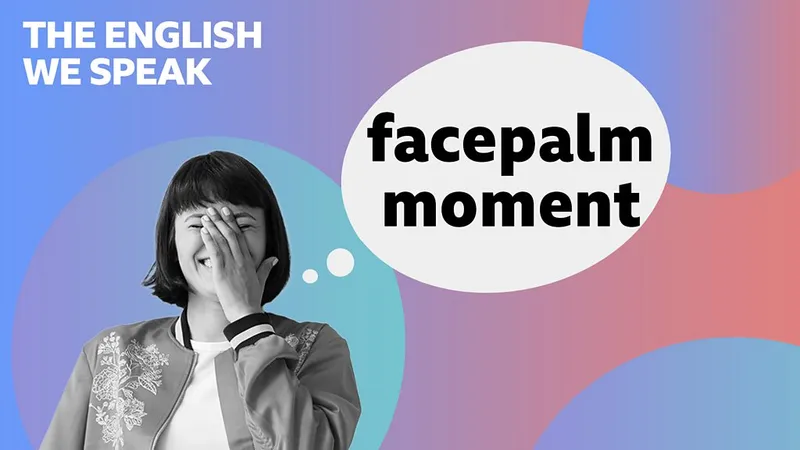
Phil See, look, now you’re facepalming as well. Let’s learn that expression ‘facepalm moment’. I should describe how Feifei looks right now – she’s sat opposite me and has her head in her hands.
Feifei Yes! So, the noun ‘facepalm’, comes from the nouns ‘face’ and ‘palm’ – your palm is the surface of your hand. A facepalm is where you have your head against the palm of your hand because you’re embarrassed, annoyed or frustrated. Something that makes you do that, is a facepalm moment.
Phil Maybe you sent an email to the wrong person, or maybe you’ve just dropped a cup of coffee. The facepalm moment is when you realise that you’ve done something wrong or silly. Sometimes you might do it in response to someone else doing something wrong or silly.
Feifei Yes. Let’s hear some examples of other people using the expression ‘facepalm moment’.
**Examples
**I travelled two hours to take photos of this amazing sunset and then I realised I forgot my camera. What a facepalm moment!
Someone was waving at me, so I waved back and then I realised they were waving at someone else. It was a bit of a facepalm moment.
I had a facepalm moment today when I was sending a very detailed voice note to my mum and then I realised I hadn’t pressed record.
Feifei We’ve been learning the expression ‘facepalm moment’ to describe an embarrassing situation.
Phil Yes, we often talk about a facepalm moment, but remember that we do sometimes use the word ‘facepalm’ on its own. It can be used as a noun, to describe the action and informally it is also sometimes a verb. I facepalmed so hard when I realised I’d left my trousers at home.
Feifei I was certainly facepalming very hard when you told me that you’d forgotten your trousers.
Phil I can’t believe I did that – so embarrassing! That’s it for this programme, but join us next time to learn more English phrases and expressions.
Feifei That’s right. See you next time! Bye.
Phil Bye.